
Future-proof your marketing growth with Server-Side Tagging
Improve campaign performance and reduce costs with an easy-to-use, integrated Server-Side Tagging and consent management solution. Make the move to a first-party system to gain control of your tracking and send higher-quality data to your ad channels.
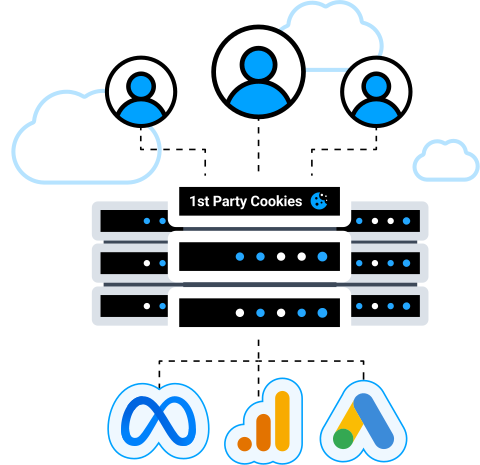
Integrate server-side tagging with your advertising and analytics platforms

Google Ads
Increase your Google Ads conversions and overall site performance by moving to Server-Side Tagging.
View documentation
Meta
Deliver consent-aware events to Meta Conversions API (CAPI) via sGTM to curb signal loss, including on iOS, and strengthen attribution.
View documentation
Send conversion data from your server to the LinkedIn Conversion API to improve lead tracking and campaign performance.
View documentation
TikTok
Stream events to the TikTok Events API from sGTM for steadier attribution and faster optimization.
View documentation
Google Floodlight
Send cleaner, de-duplicated event data from sGTM to Google Floodlight (Counter and Sales) for more reliable, privacy-compliant path-to-conversion measurement.
View documentation
Awin
Capture affiliate conversions server-side and forward to Awin with durable, consent-aware identifiers to protect payout accuracy.
View documentation
Microsoft Bing Ads
Forward conversions via sGTM to improve UET signal quality and modeled performance across Microsoft Advertising.
View documentation
Snapchat
Pipe events to Snapchat’s Conversions API through sGTM to strengthen tracking and boost campaign learning.
View documentation
Use server-side Google Tag Manager to send consent-aware events to Pinterest Conversions API for higher-quality signals and more precise targeting.

Augment your Reddit pixel by also sending data to the Reddit Events API (CAPI) using a server-side container.
Server-Side Tagging: Benefits backed by industry case studies*
Capture conversions, improve your ROAS
Find out how Server-Side Tagging helps you recover data and get more from your ad spend.
Calculate ROASImprove performance with Server-Side Tagging
See how Usercentrics Server‑Side Tagging improves campaign results and strengthens user privacy.
What is Usercentrics Server-Side Tagging?
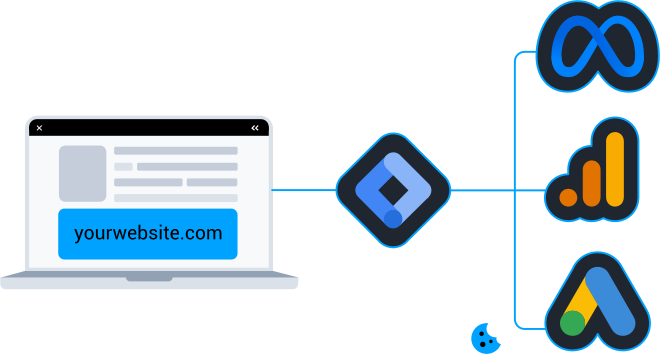
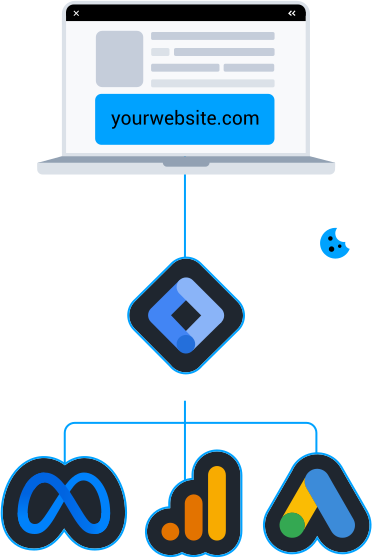
Usercentrics Server-Side Tagging hosts your Google Tag Manager container on a secure server. Compared to client-side tagging, it sends cleaner, more accurate, and consented data to your ad tools — helping you control your data and get better results from your marketing campaigns.
Built for marketers, trusted for compliance.
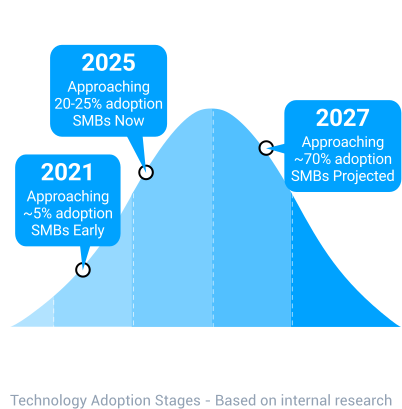
Server-side tracking is the future — don’t fall behind
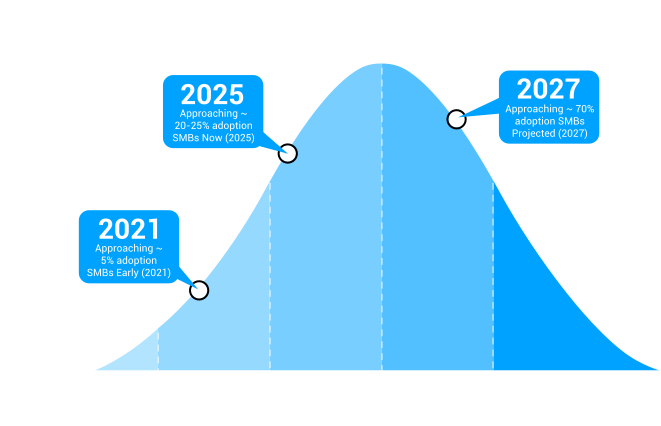
According to our research*, adoption of server-side tracking has grown rapidly, reaching 20–25% of SMBs since 2020. By 2027, it’s expected to become the standard for data-driven organizations, with 70% adoption projected across the industry.
Now is the time to act. With Usercentrics, what used to require deep technical knowledge is now fast, simple, and code-free. Get ahead while most businesses are still catching up.
How to get started
Our managed Server-Side Tagging solution gets you up and running fast thanks to pre-built templates for the top ad channels and integrated privacy compliance.
We provide:
- Easy launch: Start fast with pre-built templates for GA4, Google Ads, Meta (CAPI), and more
- Managed solution: Handle traffic spikes with a solution that autoscales servers to match demand
- Built-in consent: Easy integration with the Usercentrics Web CMP
- Start free: No cost for up to 20,000 server-side requests/month

What customers are saying about Server-Side Tagging
Optimise marketing performance with Server-Side Tagging
Usercentrics Server-Side Tagging helps future-proof your marketing measurement strategy by improving data quality and reducing dependence on third party cookies, trackers, and data.
Optimise your page speed for downstream benefits

More, better quality data
A reduction in third-party tracking scripts leads to faster page load speeds. This can in turn result in reduced bounce rates and increased opt-in (consent) rates, which impact your overall data volume and quality. This helps mitigate the data loss some marketers experience when they first deploy a cookie banner or consent management platform.

Increased conversion rates
An increase in on-page engagement means time-on-site increases, as does the percentage of people achieving your conversion goals. This has a knock-on effect of reducing your CAC (Customer Acquisition Costs), leading to higher conversion volumes, more customers and ultimately to an acceleration of business growth.

SEO ranking boost
Google's Core Web Vitals metric uses various speed-focused metrics as ranking signals. Third-party tracking scripts in the browser have a negative impact on page performance. By moving your tracking infrastructure server-side, you can see page performance gains, leading to increased organic search volume, and ultimately, more conversions.
Chat with our product team
Curious how Usercentrics Server-Side Tagging fits your stack or use case? Talk directly with the people who built it — no fluff, just answers.
 Book a call now
Product features
 Coming soon Coming soon
 Frequently asked questions
With Server-Side Tagging, instead of sending data directly from a user’s device to third parties, tracking data is sent first from the device to a “tagging server” that you control (a ‘first party’ server), typically hosted on your own sub-domain (e.g. analytics.yourwebsite.com), allowing you to decide how and what you may share with third-parties.
Server-Side Tagging helps maintain accurate, reliable, and compliant data collection practices. This is especially important in a landscape increasingly defined by privacy regulations and browser restrictions. Plus, Server-Side Tagging improves website performance and provides centralized control, so it’s a strategic solution to future-proof your online marketing and gain better control over data flows.
*The figures presented are based on an analysis of the studies below; actual results may vary depending on your business setup and potential data tracking limitations. Usercentrics has not independently verified the accuracy, completeness, or reliability of the underlying data, and has only analyzed and interpreted the information therein. Usercentrics makes no representations or warranties, express or implied, regarding the validity or quality of the source data.
| Funnel Metric / KPI | Detail | Source link |
|---|---|---|
| Bounce‑rate driver (page‑load / LCP) | Up to 5.6 s faster page‑load and an 11 % ↓ in LCP for a multinational retailer after Adobe‑suite tags were migrated server‑side — a performance delta Google research links to materially lower bounce risk (see §2) | Thinkwithgoogle.com |
| Add‑to‑cart and checkout data capture | Nemlig moved “add to cart” and other high‑volume events into a GTM server container, eliminating collector‑side throttling and delivering a 40 % jump in 90‑day conversions from new shoppers | marketingplatform.google.com |
| Sign‑up / first‑transaction tracking | Square enriched server events (e.g., first payment) and saw +46 % more conversions recorded across channels, enabling smarter bid strategies | marketingplatform.google.com |
| Overall conversion‑rate |
| https://cosmoforge.io/ |
| Cost per acquisition (CPA) / CAC |
| https://cosmoforge.io/ newpathdigital.com |
Client-side GTM runs JavaScript in the browser. This gives you limited control over exactly which data is captured and processed, apart from opting in or out per service or category.
Server-side GTM runs in a secure cloud environment that you control. It provides you with more oversight of data processing before it reaches vendors. You can also improve data quality and enrich data flows with consented zero- and first-party data.
If you are a performance marketer or the founder of a growing business, this solution is for you.
Our Server-Side Tagging product is a managed platform designed to improve the reliability of your measurement, and give you greater control over the data you share with third parties. It is based on server-side Google Tag Manager (sGTM), an industry-leading solution for Server-Side Tagging.
Unlike competitors, we offer an out-of-the-box integration with the Usercentrics Web CMP (Consent Management Platform) signals, making achieving compliance with data privacy laws easier. Our solution also supports sending compliant conversion data to Google Ads, Meta (CAPI), using trusted community tag templates, with other channels also supported.
With the Starter Plan you can create and use a free server-side Google Tag Manager (sGTM ) container, which can handle up to 20,000 requests per month, 1 custom domain, and consent integration with the Usercentrics Web CMP.
Paid plans include:
- Hosting for multiple tiers of requests over 20,000 per month
- Data processing for one or more server-side GTM container and for one or more custom domains, depending on the selected plan
- Consent integration with the Usercentrics Web CMP
A request is a tracking "hit" sent from the user's browser to the tagging-server, usually triggered by a page load or event.
The Usercentrics Server-Side Tagging containers are hosted in a cloud environment that can increase the number of server instances that back them, based on load. This means your container can handle traffic peaks.
We are providing implementation support via documentation, with further support options to be rolled out during the coming months.
Usercentrics Server-Side Tagging free version is available for early access. Paid plans will be launched soon, so stay tuned!
Yes, it works with both. Server-Side Tagging can be used beyond websites — including mobile apps and server-to-server setups.
Follow the steps here: Set up Server-Side Tagging for mobile apps
Yes, it can definitely work. Server-Side Tagging can also be used outside of a website context – either mobile or server-to-server.
Here are the steps you can take: https://developers.google.com/tag-platform/tag-manager/server-side/server-side-tagging-for-mobile-apps
*Our research was based on sources such as:
- Google developers blogs
- Fortune Business Insights – Tag Management Market Report
- Fresh Egg
- Awin – 2024 guide to S2S tracking